
Start Free Trial Start Free Trial

You can't automate a shambles - 4 steps to systemise work before you automate
When capacity is tight, the instinct is often to reach for a solution quickly.

Hire another person. Move work offshore. Add a new platform. Automate the task.

Any of those options might be right. But if the underlying process is unclear, inconsistent, or unnecessary, the firm risks moving the same problem somewhere else - or making it happen faster.

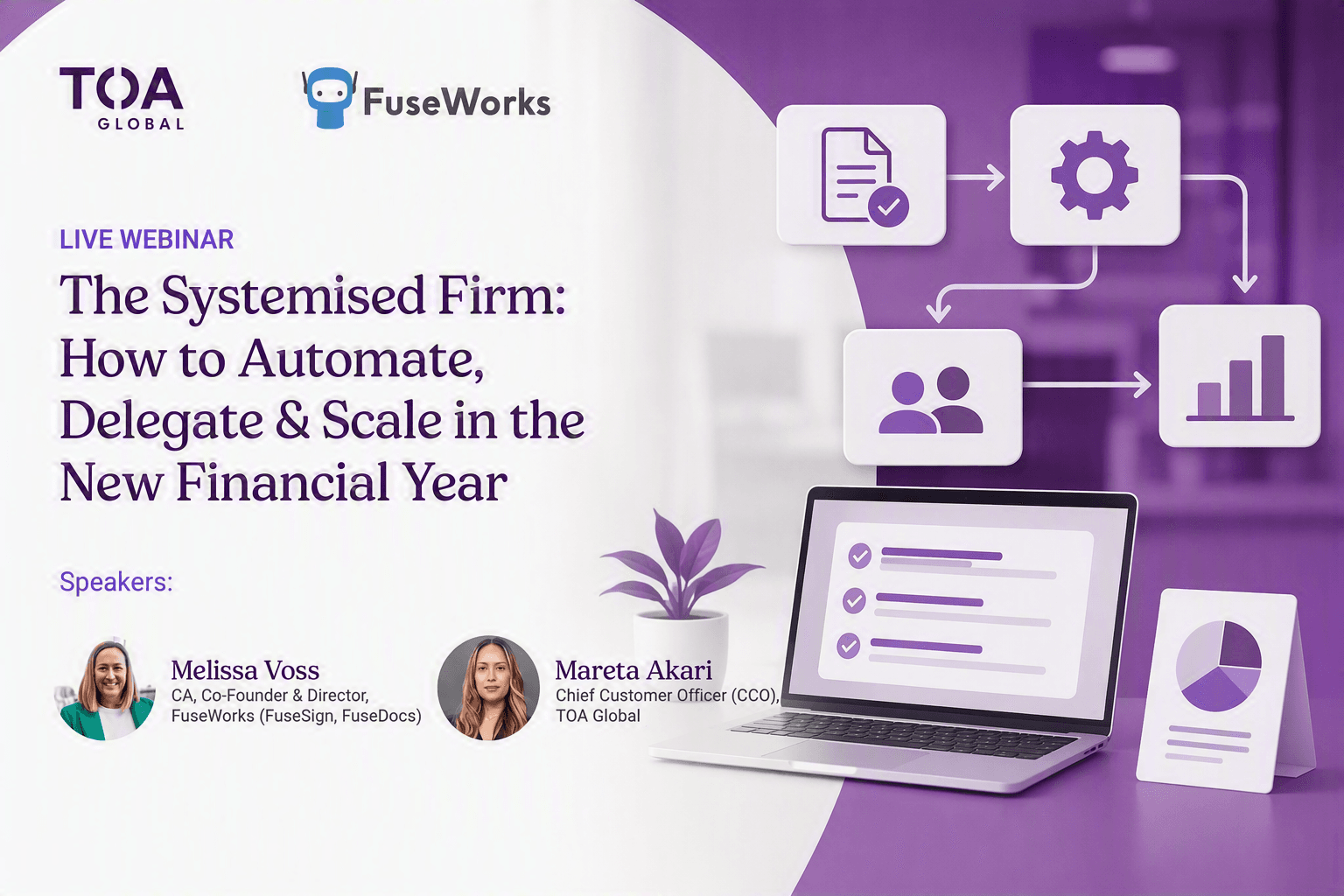
In our recent webinar with TOA Global, FuseWorks co-founder Melissa Voss explored what it takes to build a more systemised accounting firm.

One message came through clearly: capacity is not solved by people or technology alone. It comes from understanding the work first, then bringing process, people, and technology together in the right way.

"You can't automate a shambles. You need really defined systems and processes first, then you can get people and technology to support that."
- Melissa Voss, Co-Founder, FuseWorks

For firms wondering where to begin, the conversation can be turned into four practical steps: Map, Fix, Allocate, and Measure.

Before choosing a solution, get clear on where the work is actually getting stuck. That means looking beyond the obvious symptom, usually a lack of capacity, and examining the tasks, handoffs, delays, and decisions underneath it.

Melissa described starting with a simple list: which tasks were frustrating the team, producing inconsistent outcomes, or sitting with someone who no longer needed to do them? At that stage, the answer was not assumed to be automation or offshoring. The point was to understand the work before deciding what should happen to it.

For an accounting firm, this might mean mapping:

  • Recurring administration completed by senior or client-facing team members
  • Manual preparation and finalisation steps at the end of a job
  • Document sending, signing, tracking, and follow-up
  • Billing processes that consume concentrated time each month
  • Client information requests that rely on email, paper, or individual memory

The goal is not to document every task in the firm. Start with one workflow that regularly creates delays, rework, or frustration. That gives the team a contained problem to solve rather than an overwhelming transformation project.

2 - Fix the process

Once the work is visible, ask a harder question: should this process exist in its current form at all?

A task can be repetitive and still be poorly designed. Delegating it may create capacity for one person, but it does not remove unnecessary steps, unclear inputs, or duplicated effort. Automating it can make the same inefficiency move faster.

One webinar question came from a firm spending two days each month on billing. The immediate answer could have been to give that task to someone else. Instead, Melissa encouraged the firm to reconsider the billing model and the process itself. The broader lesson is useful: redesign before you reassign.

A process is more ready to automate or delegate when:

  • The inputs are clear and arrive in a usable format
  • The steps and decision points are documented
  • Ownership is obvious
  • Checkpoints and exceptions are defined
  • The underlying data is accurate and consistent

This groundwork may feel slower than implementing a new tool, but it is what makes the eventual improvement repeatable. Clean systems and clear workflows give both people and technology something reliable to work with.

“You've got to put the work in at the beginning. Put the structures in place and define the processes people need to follow.”
- Melissa Voss

3 - Allocate deliberately

With a clearer process, the firm can decide where each part of the work belongs. Some tasks need specialist judgement. Some can be owned by a local or offshore team member. Others are suitable for automation. Many workflows need a combination of all three.

This matters because systemisation is not about removing people. It is about helping people spend more time at the highest value of their role.

A well-defined offshore position can take ownership of recurring bookkeeping, administration, preparation, or finalisation work. Technology can then support that person by standardising outputs, creating visibility, and reducing manual follow-up.

“Automate the things that can be, and leave the people to do the people part of it.”
- Melissa Voss

Document finalisation is a practical example. A team member can prepare the client package, FuseDocs can help produce a consistent branded output, and FuseSign can manage the signing workflow, reminders, and status visibility. The process still has human ownership, but fewer steps depend on manual email chains or one person remembering what happens next.

The same principle applies in a two-person firm and a much larger practice. Bespoke advisory work may remain with senior specialists, while recurring preparation, administration, document delivery, and signing can still be systemised around it.

4 - Measure and expand

The first version of a new workflow will rarely be the final one. Melissa was open about underestimating how much structure and training would be needed when FuseWorks added an offshore team member. What looked like a short onboarding period became several months of refining instructions, adding checkpoints, and creating permission to ask questions.

That investment paid off because the team treated implementation as a learning process rather than expecting an immediate, finished result.

Start with one workflow and track a small set of practical measures:

  • How much team time the process requires
  • How long work waits between steps
  • How often errors, rework, or missed follow-ups occur
  • Whether the team has clear visibility and ownership
  • Whether the client experience becomes easier or more consistent

The measures do not need to be sophisticated. They need to show whether the change is genuinely releasing capacity and improving the workflow. Once it is working, the role or automation can expand into adjacent tasks based on evidence rather than assumption.

What this looks like in practice

A systemised firm is not necessarily the firm with the most technology or the largest offshore team. It is the firm that can explain how work moves, who owns each step, where judgement is required, and what the intended outcome is.

In practical terms, that means:

  • Map the bottleneck before selecting the solution
  • Fix unnecessary or inconsistent steps before moving the work
  • Allocate tasks according to judgement, repeatability, and ownership
  • Measure the result, learn, and expand gradually

It also means treating offshore team members as part of the firm, with access to the same context, meetings, relationships, and expectations as the people sitting locally.

Clear processes create confidence, but inclusion is what turns a delegated task into genuine ownership.

“Treat an offshore team member as though they're sitting in the chair next to you!”
- Melissa Voss

    Map, fix, allocate, measure

    When a firm is busy, it is tempting to act quickly. But the most useful first step is often to pause long enough to understand the work.

    Map it. Fix it. Allocate it deliberately.

    Then measure what changes.You do not need a grand plan for the whole firm before you begin.

    Start with one recurring frustration, build a clearer workflow around it, and use what you learn to guide the next improvement.

    “Don't think you need to come up with a grand plan first. Start small, give it a go, and build from there.”
    - Melissa Voss

    For further depth on these topics, watch the full webinar to hear Melissa Voss and TOA Global discuss how accounting firms can combine people, process, and technology to create capacity and scale with greater confidence.

    © FuseWorks Pty Ltd 2012-2026 | ABN 78 159 891 335